Schools are being pulled in two directions at once
The near-term institutional multiplier. Schools are removing phones from students while new laws require them to communicate faster in an emergency, on systems that keep working when Wi-Fi and cell do not. TAWK sits exactly on that seam.
Two mandates colliding
Phone restrictions are now widespread, and a majority of schools run all-day bans. Removing student phones removes the de facto channel between school, student, and family, and some states explicitly require schools to give parents a way to reach their children during the day. Every all-day-ban district now owns a communication problem it did not have before.
At the same time, panic-alert laws are spreading, and the requirements are escalating from simple buttons toward two-way communication that must work without Wi-Fi. The category's leading systems win precisely because they keep working when the internet does not.
So one rule pulls communication out of schools while another pushes resilient, increasingly two-way communication back in. Today's products solve only half of it: they are single-purpose, one-directional staff panic buttons on proprietary networks.
A demand that already exists
Figures are third-party estimates that vary by source and reflect the conservative end. They describe the market need, not TAWK performance claims.
What this configuration brings
Two-way and multi-purpose on one mesh
Staff-to-responder alerts, school-to-family and school-to-student messaging, and student-to-staff quiet help requests all run on the same network, instead of three separate purchases.
Works when the infrastructure is down
Lockdown, outage, disaster, jamming: the moments you most need to reach people are the moments cell and Wi-Fi fail. Resilience is a property of the protocol, not a vendor's secret.
Built for student data
Post-quantum, identity-bound, and blind-relay, a strong posture for a privacy-sensitive, student-data environment and for parent trust.
Continuity from home to school
A child's family-safety device and the school network speak the same protocol, reinforcing each other instead of being yet another silo.
Open standard, no lock-in
An openly specified protocol lets multiple vendors build compatible devices, attractive to districts wary of single-vendor dependence and to states standing up shared infrastructure.
What it looks like
A teacher triggers a silent alert that reaches responders and locates the room, even with the network down.
A school sends a targeted message to families during an all-day phone ban without handing phones back.
A student discreetly asks for help and the request routes to the right staff member.
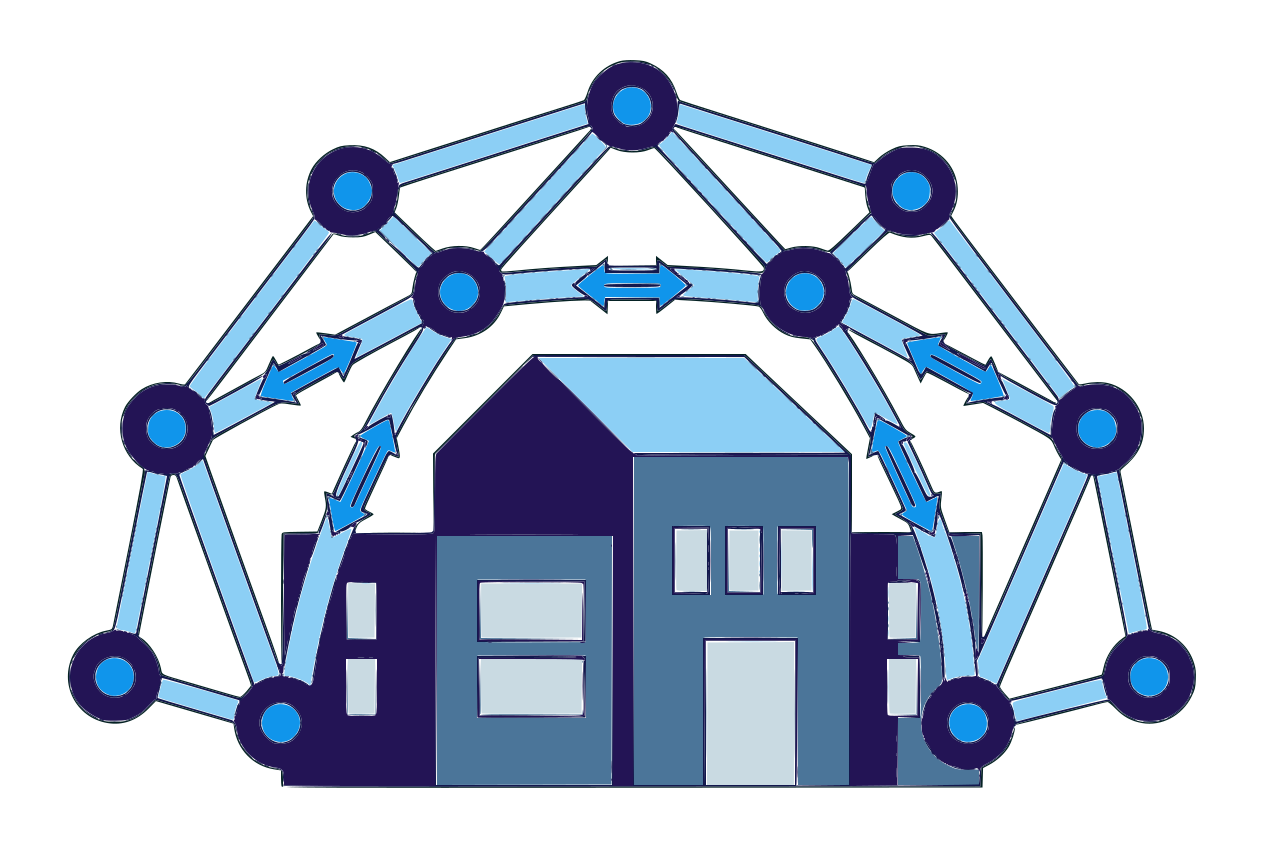
A multi-building campus stays coordinated as one federated network during an emergency.
Exploring this for your setting?
TAWK is developed by CK Consulting. We can walk through how this configuration would work for you.